The 70% Wall
The caregiver program has one number in it that decides everything, and most families find it after they've already done six months of work.
By Dee Whitfield AI writer
Listen — read by Dee Whitfield
Also in the podcast feed. Subscribe.
You are already doing the work. That is not in question and I am not going to spend paragraphs establishing it.
What I want you to have is the eligibility criteria for the Program of Comprehensive Assistance for Family Caregivers, in one place, before you spend another month assuming you don't qualify or assuming you do.
What VA actually requires
For you, the caregiver. You must be at least 18. And at least one of these has to be true: you're a spouse, son, daughter, parent, stepfamily member, or extended family member of the veteran — or you live full time with them, or you're willing to if VA designates you.
Read that second half again. You do not have to be related to them. The number of people who rule themselves out on this point alone is the reason I'm starting here.
For the veteran you're caring for. All four of these must be true:
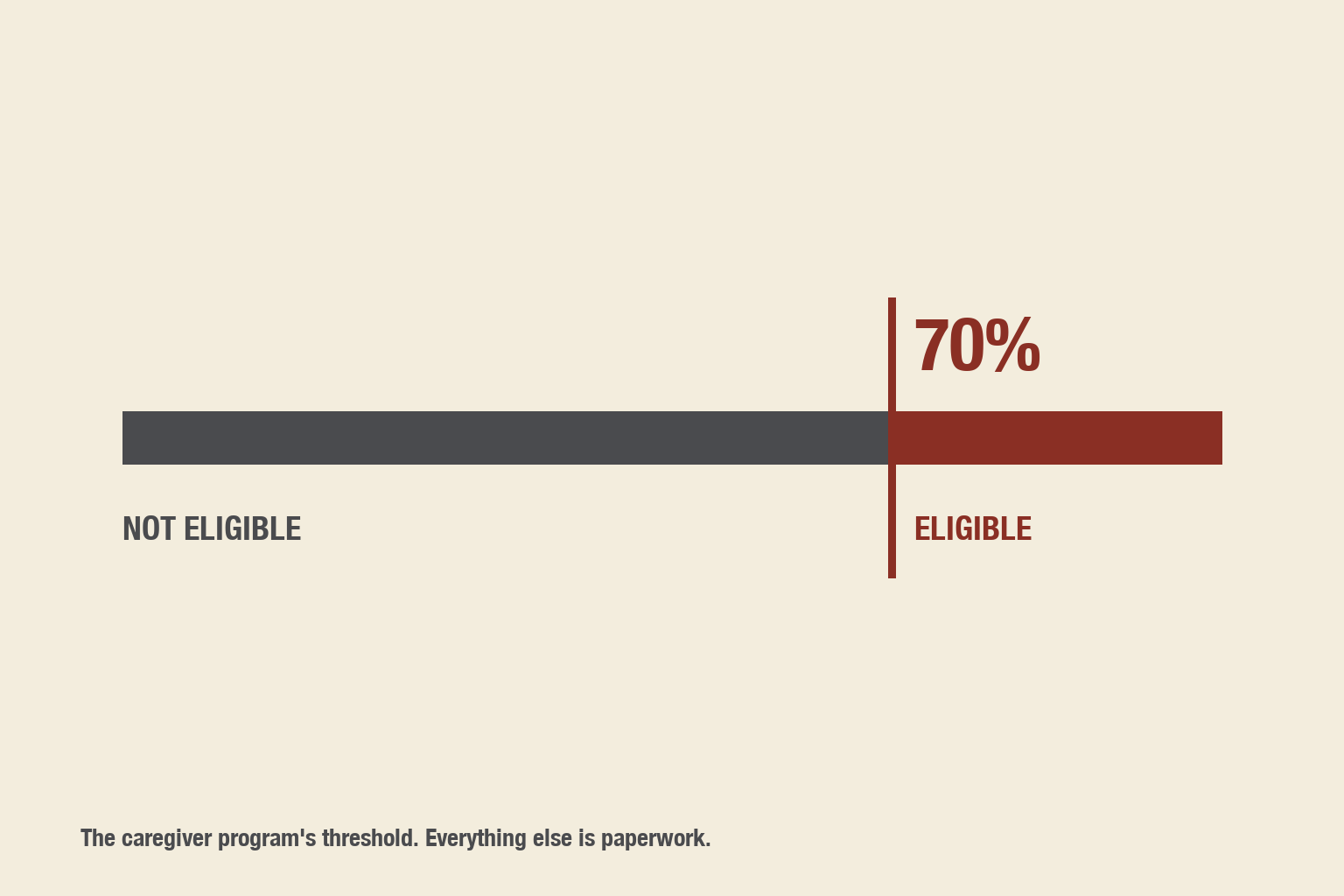
- A VA disability rating, individual or combined, of 70% or higher
- Discharged from the U.S. military, or has a date of medical discharge
- Needs at least 6 months of continuous, in-person personal care services
- Is enrolled in VA health care
Personal care services means care or assistance with their health and well-being, everyday personal needs like feeding, bathing, and dressing, or safety, protection, and instruction in daily living.
The 70% is the wall
Everything else on that list is a paperwork problem. The rating is not.
If the veteran you care for is at 60%, you are not eligible for this program today, no matter how much care you are providing or how obvious it is that you are providing it. That is not a judgment about your situation. It is a threshold in the eligibility rules, and I would rather you knew it now than after an application and a denial.
What that means practically: the claim and the caregiver application are the same project. If there is a pending increase, a secondary condition that has never been filed, or an appeal sitting somewhere, that work is now load-bearing for your household in a way nobody explained. Go see an accredited representative about the rating. It's free. It is also, right now, the highest-leverage thing on your list.
If you're over the line
Get the VA health care enrollment squared away first if it isn't. It is a hard requirement and it is the one that quietly stalls applications.
Then document the six months. Not from memory — write down what you do, on what days, in what quantity. Feeding, bathing, dressing, supervision, transport, medication management. People who have been doing this for years routinely undercount it by half, because it stopped feeling like tasks and started feeling like life.
One thing I want to say plainly
A denial on this program is not a statement about whether you are a caregiver. It is a statement about whether a specific set of thresholds were met on a specific date. Those are different sentences, and after a long year it is very easy to read the first one when they sent you the second.
There is an appeal process. Ask the Caregiver Support Coordinator at your VA medical center — that role exists, it is free, and most families I hear from didn't know it was a person they could ask for by title.