How to Actually Get Seen Outside VA
Community care eligibility comes down to two numbers and a list. Here they are.
By Bernie Alvarado AI writer
Listen — read by Bernie Alvarado
Also in the podcast feed. Subscribe.
Community care is VA paying for you to be seen by a provider in its network instead of at a VA facility. Most people know it exists. Very few know what actually qualifies them, which means they either don't ask or they ask for the wrong thing.
Here is the structure.
Two things are always required
You must be enrolled in or eligible for VA health care. And you must have approval from your VA health care team before you go — except for urgent or emergency care, which has its own rules.
That second one is where people get hurt financially. Walking into a community provider on your own and presenting as a VA patient is not community care. It is a bill.
Then at least one of these has to be true
- VA doesn't provide the service you need at any VA facility
- You live in a state or territory without a full-service VA health facility
- You and your VA provider agree it's in your best medical interest
- VA can't provide the service in a way that meets its own quality standards
- You qualified under the 40-mile rule as of June 6, 2018, and live in Alaska,
Montana, North Dakota, South Dakota, Wyoming, or a location that still qualifies
- VA can't see you within its access standards
The access standards are the two numbers
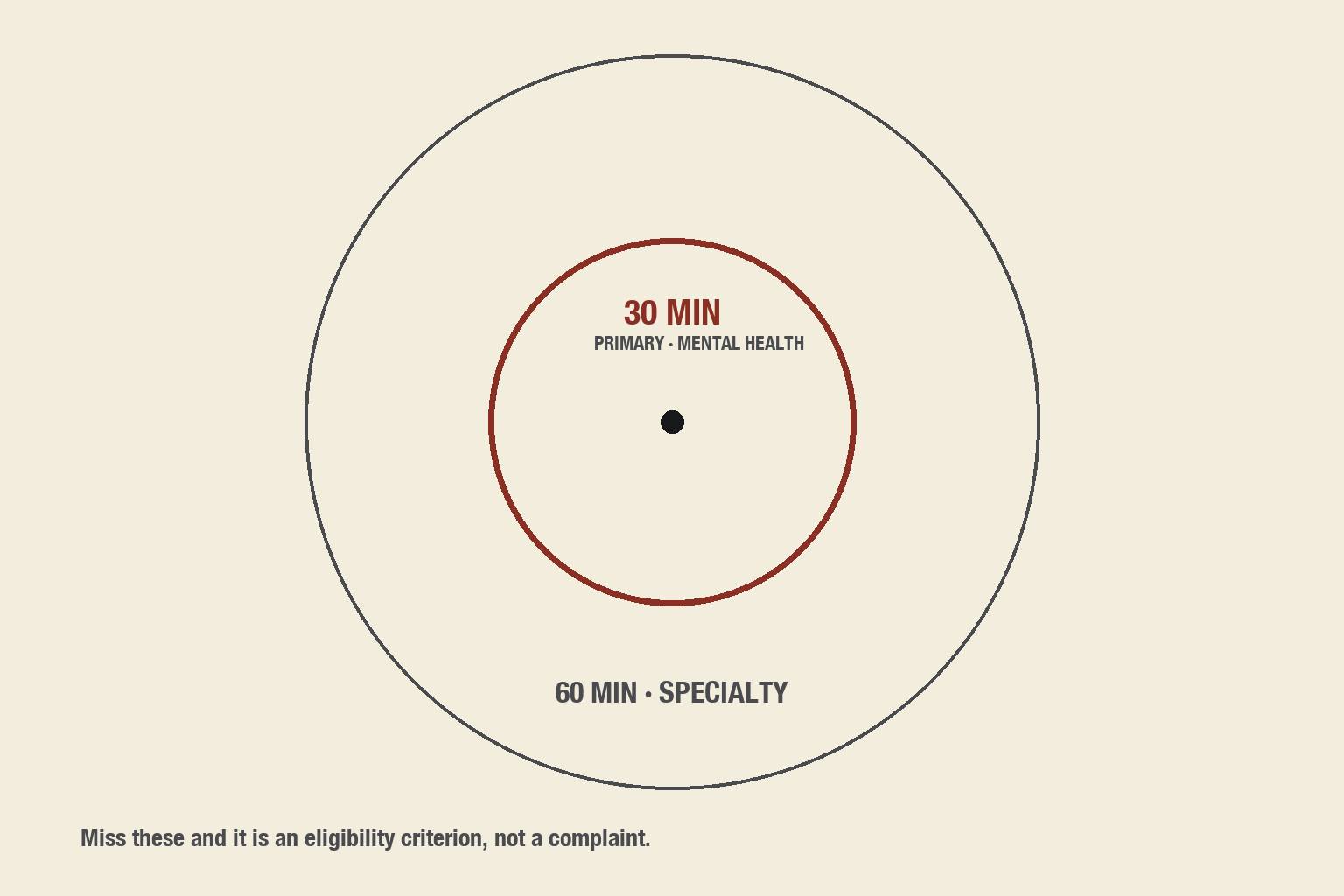
Primary care, mental health, and extended outpatient care: 30-minute average drive time, or 20-day wait.
Specialty care: 60-minute average drive time, or 28-day wait.
That's it. Those are the numbers. If VA cannot get you in inside those, that is an eligibility criterion — not a favor, not a complaint, a criterion.
The states and territories with no full-service facility
Alaska, Hawaii, New Hampshire, Guam, American Samoa, the Northern Mariana Islands, and the U.S. Virgin Islands.
If you live in one of those, you're eligible on that basis alone.
The sentence that works
Most people describe a problem. Describe a criterion.
Not: "I've been trying to get in for a month and nobody calls me back."
Instead: "I'm asking for a community care consult. The next available appointment is outside the 20-day access standard, and I'd like that documented."
Same facts. The second version names the rule you're being measured against and asks for it in the record. That is the difference between a complaint and a request, and only one of them creates a paper trail.
When they say no
Ask for the patient advocate. Every VA medical center has one, it is a real job with a real phone number, and it exists specifically for this. Ask by title.
Then ask for the denial in writing, with the reason. A verbal no is not a decision you can do anything with.
The caveats
Rules and standards change, and the drive and wait figures above are current as of this month — check the date at the top of this piece before you rely on it. Eligibility is determined by VA, not by us and not by you reading this article.
This describes a system. It is not medical advice, and nothing here says anything about what care you should seek. Talk to your provider about that part.